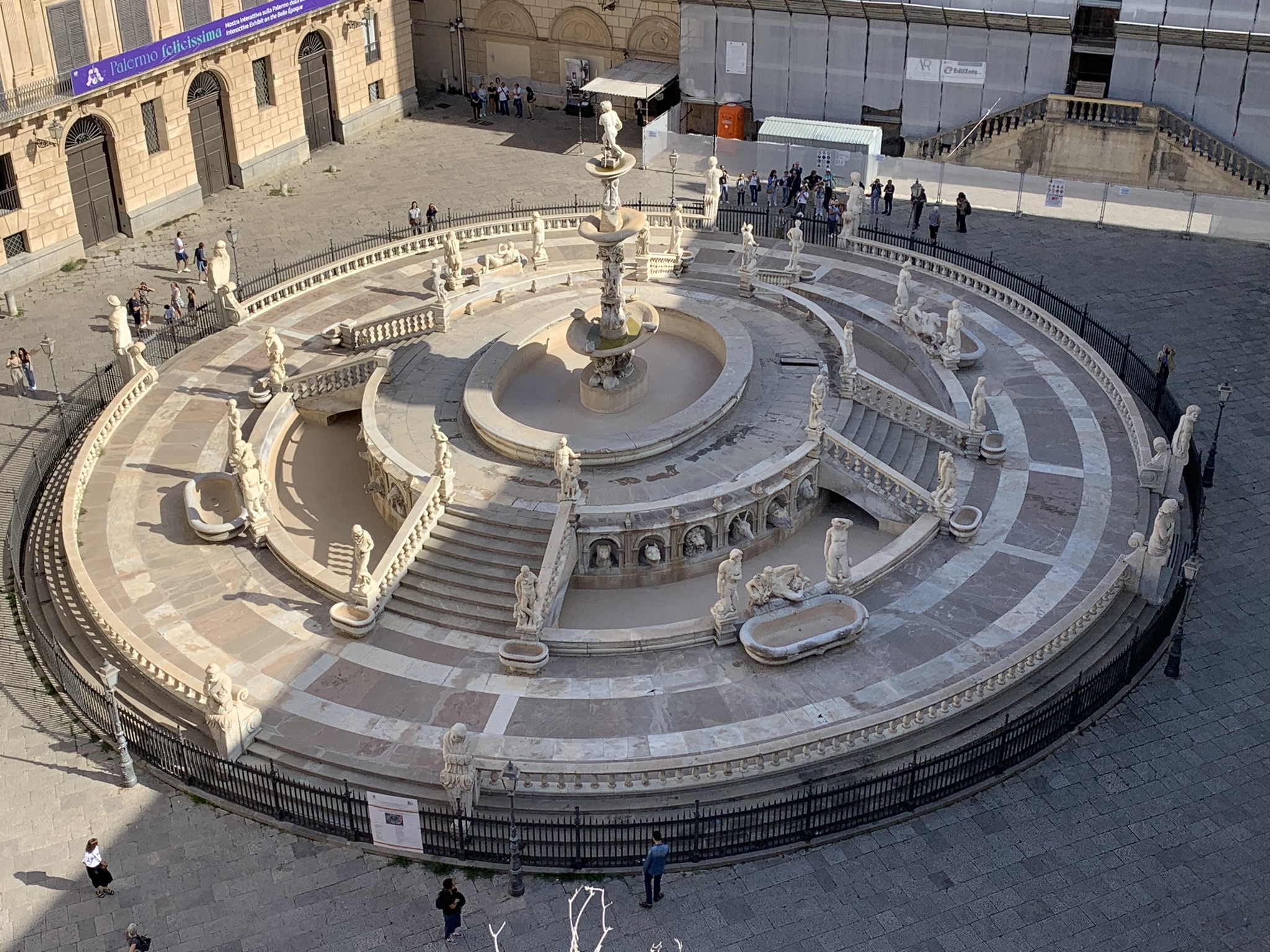
In this video, I am at Piazza Pretoria in the heart of Palermo’s historical district.
When you think of Italy, many famous squares come to mind.
Famous Squares in Italy

Most notably there is the Piazza Navona in Rome, Italy. There is also Piazza San Marco in the iconic city of Venice.
However, Piazza Pretoria in Palermo is probably one that you never heard of and also one of the most beautiful in all of Italy.
I will go over the fascinating history of this square in the video. There is also a scandalous story about this piazza that not many people know about as well.
Francesco Camilliani designed this piazza in 1554 for a Florentine nobleman by the name of Don Luigi Toledo. Mr. Toledo was the father-in-law to Cosimo de’ Medici. The Medicis were a powerful and influential Florentine family involved in banking and finance.
These statues were designed and originally used for a Florentine villa.
After Don Luigi Toledo passed away in 1573, his estate was plagued with many debts, so the family could not afford to keep it.
The Palermo City Council wanted to embellish the image of the city during this time frame.
Therefore, the city of Palermo decided to purchase the pieces, 644 in total, and have them placed at the current location in Palermo’s historical center.
The original layout was not in the manner it is now in Palermo.
The pieces consist of various Greek mythological creatures, dolphins, nymphs, etc.
There are four basins in the plaza. Each basin represents each of the ancient rivers that ran through Palermo.
Encircling Piazza Pretoria is a gate. Architect Giovan Battista Filippo Basile designed the gate. He is the same architect who designed the Teatro Massimo, also in Palermo’s historical center. The Teatro Massimo is Italy’s largest opera house and the third largest in all of Europe.
Transporting Pieces to Palermo

Think of the transport that had to occur to get the pieces from Florence to Palermo. There were no cars, trucks, or cranes in those days.
They probably had to use donkeys and mules to transport the pieces through the town. I’m guessing they had to take the pieces from Florence and go down the Arno River to the west. And then they would arrive at the Ligurian Sea and be placed onto a boat.
At the end of the voyage, they would arrive at the Port of Palermo. At that time, they would be transported a few kilometers from the Port to its current location. Again, they probably used mules and donkeys for transport from the Port.
The City of Palermo had to buy houses from people who were living in this location at that time. They were probably very influential and rich people living in this central part of the city.
The concept of eminent domain was probably used to purchase the land required to arrange the pieces of the current Piazza Pretoria.
Scandalous Controversy for Piazza Pretoria
There are other names known for this famous square in Palermo.
It also goes by the names listed below:
Piazza della Vergogna – Shame Square
Fontana della Vergogna – Fountain of Shame
The reason is that this square is found near a couple of churches. There is the Church of San Giuseppe dei Teatini across the street and the Church of San Cataldo. The latter is famous for its three red domes.
Legend has it that the nuns of these churches were flabbergasted when the City of Palermo bought these statues because some depicted nudity. It was considered very scandalous for those times.
And to display their anger and displeasure, they would come out in the darkness of the night and castrate the male statues. I am not certain that is true, but I would not be surprised.
To get to Piazza Pretoria in the heart of Palermo’s historical district Palermo:
It is a quick and easy walk from the Quattro Canti, which is considered the historical center of Palermo.
Quattro Canti is an intersection of two streets that cross and there are four Baroque-style buildings on each corner. It is a truly magnificent architectural sight to behold.
You may be interested in: Complete travel guide book to Palermo, Sicily on Amazon